TRX Supercharger Upgrade Guide: Pulleys, Heat Exchangers & Tunes
How to actually add power to the Ram 1500 TRX's supercharged 6.2L HEMI — why heat management comes before boost, what a pulley swap really requires, where the fuel system and drivetrain become the limit, and the maintenance the blower needs either way.
Parts Covered in This Guide
Owners wanting more power and response
| # | Product | Owner Reviews | Availability | Best For | |
|---|---|---|---|---|---|
| 1 | 3,634 | $269.99 In Stock at Amazon | Owners wanting more power and response |
Shopping used, OEM or factory-takeoff? Start on eBay Motors
Live listings for the parts this guide covers — prices set by the seller.
The TRX left the factory with 702 hp and 650 lb-ft from a supercharged 6.2L HEMI (figures confirmed on the Ram 1500 TRX’s Wikipedia entry). That is the starting point, and it changes the entire conversation about modifications: on most trucks you add parts to find power that the factory left on the table, but here the factory already went looking. What is left is not a pile of easy bolt-ons — it is a sequence of decisions where doing them in the wrong order costs money and, occasionally, an engine.
This guide lays out that sequence honestly: what actually limits a supercharged TRX, what a pulley swap really requires, where the fuel system and driveline become the wall, and the maintenance the blower needs whether or not you touch it. For new parts, follow the engine & performance category; for used, take-off and OEM blower hardware, use the eBay Motors buttons further down.
The honest stage map
Think in stages, and do not skip forward. Every stage below makes the next one safer.
| Stage | What it is | Why it comes here |
|---|---|---|
| 0 — Baseline | Correct fluids, healthy plugs, supercharger oil on the radar, good fuel | A tired truck makes a bad platform. Fix maintenance before adding load |
| 1 — Heat | Larger heat exchanger, higher-flow intercooler pump, bigger coolant reservoir | Heat, not airflow, is what makes a TRX go soft. This stage often returns the most usable power |
| 2 — Breathing + calibration | Sealed cold air intake, cat-back exhaust, supporting tune | The tune is what turns airflow into power. The exhaust is mostly sound — buy it for that |
| 3 — Pulley | Smaller upper pulley, matching belt and tensioner, colder plugs, revised tune | The first real boost increase. Requires all of the above to be sane |
| 4 — Fuel | Pump and injector capacity, fuel-quality discipline | More boost needs more fuel. This is where “just a pulley” stops being enough |
| 5 — Blower | Bigger or upgraded supercharger, snout and rotor-pack work | Big money, big supporting-parts list. Only after everything above |
Most owners get the best result-per-dollar from stages 1 and 2, and the truck is genuinely transformed in how it holds power rather than what it peaks at.
Stage 1: heat is the real bottleneck
This is the part people learn the hard way. A supercharger compresses air, and compressing air heats it. The TRX’s air-to-water intercooler dumps that heat into a coolant loop that runs to a front-mounted heat exchanger. Under sustained hard use — repeated pulls, a long dune run, a 105-degree day — the loop cannot shed heat as fast as the blower makes it. Intake air temperature climbs, the ECU pulls timing to protect the engine, and the truck goes soft.
No amount of boost fixes that. More boost makes it arrive sooner.
The three parts that address it directly:
- A larger front-mount heat exchanger — more surface area for the intercooler coolant to shed heat into ambient air. The single most effective piece.
- A higher-flow intercooler coolant pump — moves heat out of the intercooler faster so it can actually reach the exchanger.
- A larger coolant reservoir — more thermal mass in the loop, so it takes longer to saturate on a hot day.
This is also the fix for the number-one complaint in our common TRX problems guide: the truck that feels ferocious on the first pull and merely quick on the third. Cooling work is unglamorous — there is no sound change and no dyno headline — but it is the difference between a truck that makes its power once and one that makes it repeatedly.
Stage 2: airflow and the tune
The cold air intake conversation is covered in depth elsewhere, and the short version applies here: a sealed airbox with quality filter media is the right choice on a truck that sees dust, and an intake alone is a modest gain plus a sound change. The exhaust is honestly a sound-and-weight upgrade — the blower is the restriction, not the tailpipes.
What actually converts those parts into power is the calibration. A tune adjusts spark, fuel and the transmission’s behavior to the hardware you have bolted on and the fuel you are actually running. Three things worth being blunt about:
- Tune quality is not a commodity. A canned file that was never adjusted for your hardware, your fuel and your climate is doing arithmetic on assumptions. A tuner who logs your truck is doing engineering.
- The tune must know your fuel. A calibration written for consistent premium is not safe on whatever is in the tank at a rural station. Be honest with your tuner about what you will realistically run.
- Tunes change what your plugs need. Under boost, spark plugs work far harder than in a naturally-aspirated truck. Tuned trucks commonly step to a colder heat range with a tighter gap. Match the exact plug and gap your tuner specifies — on a boosted engine, the wrong heat range is a genuine failure mode, not a preference.
What a throttle controller does — and does not do
A throttle-response controller remaps how pedal travel translates to throttle-plate opening. It makes the truck feel sharper off idle, which many owners genuinely like, and it is a plug-and-play, fully reversible change. What it does not do is add power, boost or airflow. Treat it as a driveability accessory, not a performance modification — and do not let a sharper pedal convince you the truck got faster.
Stage 3: the pulley swap — what it actually involves
This is the modification people mean when they say “supercharger upgrade,” and it is the one most commonly under-planned.
The principle is simple: the supercharger is belt-driven, so a smaller upper (blower) pulley spins the rotor pack faster relative to the crank, which raises boost. What it drags along with it is not simple:
- A revised tune. Non-negotiable. The stock calibration has no idea boost went up, and the resulting knock risk on a supercharged 6.2 is exactly the expensive kind.
- Belt and tensioner. More boost means more parasitic load on the drive belt. Belt slip at high rpm is a classic pulley-swap symptom, and it robs the very boost you paid for. Plan on the correct belt length for the new pulley diameter and, on larger steps, an upgraded tensioner or idler setup.
- Spark plugs. See above — colder heat range, tighter gap, per your tuner.
- Fuel. Higher octane, consistently. If your tuner asks for a specific octane, that is a requirement, not a suggestion.
- Heat capacity. Every psi you add is heat you must reject. If Stage 1 was skipped, the truck will simply reach its thermal limit sooner and you will have paid for boost you cannot use.
- Installation reality. Pulley changes on this blower family typically require a press or a dedicated puller/installer, and on larger steps a snout upgrade rather than a pulley alone. This is not a driveway job with hand tools for most owners.
A modest pulley step on a well-cooled, properly tuned truck is a satisfying and reasonably conservative modification. A large step on a stock cooling system with a canned tune is how people end up with a very expensive lesson.
Stage 4: fuel — the quiet limit
Boost is only useful if the fuel system can feed it. Beyond a modest pulley step, the honest questions become pump capacity, injector capacity and whether you are running at the top of the factory system’s ability. Signs you are at that wall are things a tuner sees in logs long before you feel them: fuel pressure falling off at the top of a pull, or the calibration hitting its correction limits.
Two rules that keep this stage safe:
- Fuel-system work is a tuner-led decision, not a shopping decision. Buy what the person writing your calibration specifies for the target you agreed on.
- The TRX is not a factory flex-fuel truck. E85 is not a fill-up choice here; it is a conversion involving fuel-system hardware and a dedicated tune. Run the premium octane your manual and fuel-door label specify unless you have deliberately built for something else.
Stage 5: bigger blower territory
Beyond pulleys and fuel, the path leads to supercharger hardware itself — a larger-displacement or higher-efficiency blower, or rotor-pack and snout work on the existing unit. This is a genuinely different budget, and it drags along everything below it: cooling, fuel, calibration, and increasingly the driveline.
It is also the area where used and OEM parts matter most. Take-off blowers, snouts, pulleys and heat exchangers from other builds circulate constantly, and eBay Motors — not Amazon — is where that market lives. The eBay buttons on this page search exactly that: used 2.4L blower hardware, pulleys, belts and heat-exchanger parts, priced by the seller.
What breaks next: the parts nobody budgets for
Adding power to a TRX moves the weak point, it does not remove it. In rough order:
- Traction. The factory 35-inch all-terrain tires already struggle to put 702 hp down. Adding boost frequently just adds wheelspin. Our wheel and tire fitment guide covers what the truck can actually run, including load-rating discipline on a 6,300-pound vehicle.
- Driveline. The 8-speed automatic’s torque converter, the driveshaft and the axles are the components that hear about your pulley long before the engine internals do.
- Brakes. A truck that accelerates harder still weighs the same. If you are adding power to a heavy truck, the brake upgrade guide and the pad compound breakdown are not optional reading — they are the other half of the modification.
- Suspension. More power plus desert use is more load. See the suspension category and the lift kit guide if the truck’s stance is changing too.
Maintenance the blower needs regardless
Even a completely stock TRX has supercharger-specific service that gets forgotten:
- The supercharger has its own oil, separate from the engine oil. Low-frequency — many owners look at it around the 100,000-mile mark or per the service manual — but real, and more important the harder the blower is spun. Full details are in the maintenance schedule and parts checklist.
- Spark plugs wear faster under boost than generic “lifetime” charts imply, and faster still on a tuned truck.
- Belt condition matters more once load goes up. Inspect it when you inspect anything else under the hood.
- The intercooler loop has coolant that is separate from the engine coolant circuit. Check its level; a low loop is a heat problem waiting to happen.
- Blow-by — the supercharged 6.2 pushes oil vapor through the PCV system into the intake, which many owners manage with a catch can. Covered in the common problems guide.
Warranty, legality and honesty
Two things worth saying plainly before you buy anything:
Warranty. Assume that raising boost puts powertrain coverage at risk. The Magnuson-Moss Warranty Act’s “tie-in sales” provisions mean a dealer cannot void a warranty merely because a part was added, but they can deny a claim where they can show the aftermarket component caused the failure (see the “tie-in sales” language on Wikipedia’s Magnuson–Moss Warranty Act entry) — and that is precisely the pulley-and-tune scenario. Some tunes leave a detectable trace in the ECU’s flash history. If the truck is still covered, treat that exposure as part of the price.
Emissions. Tunes and hardware that alter emissions equipment are regulated, and the rules differ sharply by state. Check what is legal where you actually register and drive the truck. Plenty of parts are sold as off-road or competition use only, and that label is not decoration.
Where to buy
- New bolt-on and cooling parts — heat exchangers, intercooler pumps, reservoirs, plugs, belts, intakes and catch cans — browse the engine & performance and maintenance categories. Prices are shown on Amazon, where they are always current.
- Used, take-off and OEM supercharger hardware — blowers, snouts, pulleys, heat exchangers and factory take-off parts from other builds — use the eBay Motors buttons on this page. Live seller listings, live prices.
If you take one thing from this guide, take the order: cool it, calibrate it, then boost it. A TRX that holds 702 hp through five pulls in the heat is a faster truck in the real world than one that makes a bigger number once and then hides behind timing retard for the rest of the afternoon.
Recommended Parts for This Guide
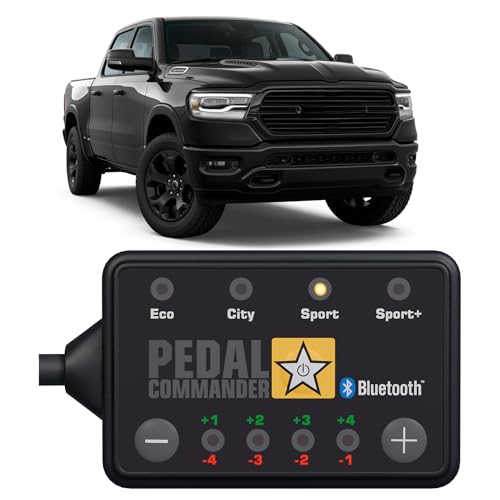
PEDAL COMMANDER for Ram 1500 New Body 2019-2026 Throttle Response Controller - Plug-and-Play 36 Settings, Wireless App Control, Anti Theft - Off-Road Performance Mods - 1500 Accessories
3,634 owner reviews
PEDAL COMMANDER for Ram 1500 New Body 2019-2026 Throttle Response Controller - Plug-and-Play 36 Settings, Wireless App Control, Anti Theft - Off-Road Performance Mods - 1500 Accessories. Add power, throttle response, and efficiency to your TRX's engine with this performance part.
- Adds power & response
- Improves throttle feel